
“Why would I pay for a loyalty program when my POS already has one built in?”
It’s the most common objection we hear from independent liquor store, smoke shop, and convenience store owners — and it’s a fair question. Clover Rewards is free at the basic tier. Loyverse’s POS is free, loyalty included. If you run a liquor-specific system like Bottle POS or LMS-POS, bundled loyalty is often marketed explicitly as the reason you don’t need “an expensive third-party marketing platform.”
So let’s answer it honestly, instead of pretending the free options don’t exist.
When free loyalty is genuinely enough
If you’re a single-location store that wants a basic “buy 10, get one free” mechanic and nothing more, a free bundled tool will do that job. You don’t need Moolah Points — or anyone else — to run a simple punch-card-style program. There’s no shame in that, and we’d rather tell you that upfront than sell you something you don’t need yet.
The free/bundled tools start to show their limits when you ask them to do three things: reward specific behavior instead of just counting visits, reach customers on the channel they actually respond to, and travel with you if you ever change POS systems. That’s where the gap opens up.
What “free” loyalty actually includes — and doesn’t
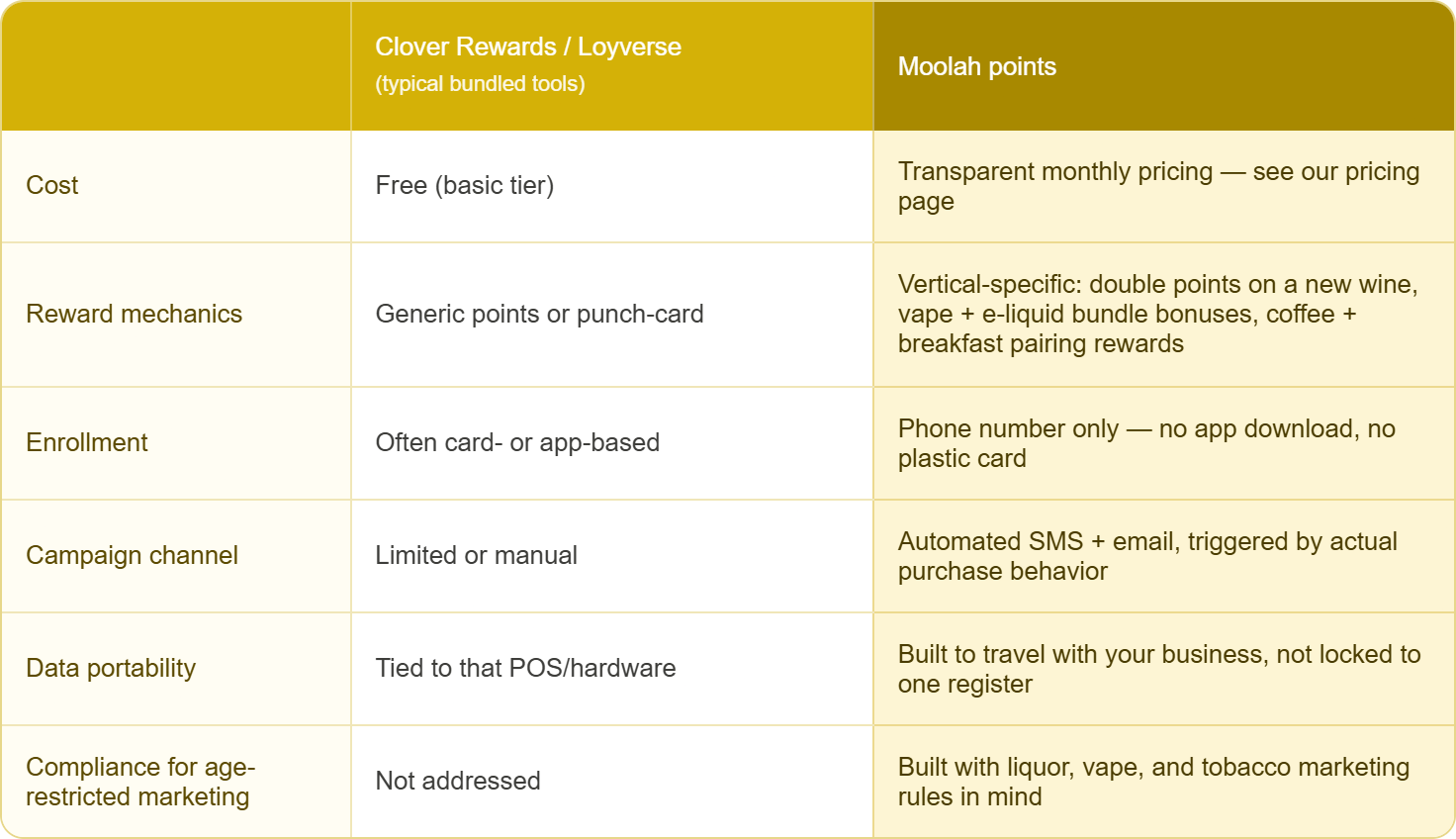
A generic points counter can tell you a customer showed up. It can’t automatically text a double-points offer to someone who tried a new wine last month, or bundle a vaporizer with the e-liquid a customer already buys. That’s the difference between “loyalty as a feature” and “loyalty as a growth tool.”
The lock-in risk nobody mentions
Bundled loyalty has a quieter cost too: it usually doesn’t belong to you. It belongs to the POS.
Toast prices its loyalty add-on as part of a “Marketing Essentials” bundle on top of the base subscription — and that customer data lives inside Toast’s ecosystem. If you ever switch hardware or providers, your loyalty program (and the customer history in it) doesn’t necessarily come with you.
There’s a real precedent for what happens when a bundled loyalty product goes away entirely: Belly, once a well-known small-business loyalty network, was acquired in 2018 and had its small-business features and consumer app discontinued — reportedly abruptly, with no clear path for merchants to export their own customer data. Free (or “included”) loyalty is only as durable as the company that built it, and it’s worth asking what happens to your customer relationships if that company changes direction.
What it actually costs you to stay on bundled loyalty
Here’s the part that’s easy to miss because a generic points counter doesn’t measure it: loyalty-member checks in convenience retail run about 12% higher than non-member checks (Paytronix, 2026), and a customer’s return-visit rate jumps to roughly 95% after their fourth visit — up from under 50% after their first. That means the payoff from a real loyalty program is front-loaded into the first few visits a new customer makes, which is exactly when a bare-bones points counter has the least to offer them.
If your current tool can’t trigger a specific offer between visit one and visit four — a welcome reward, a “come back” nudge, a bundle offer tied to what they actually bought — you’re not capturing that curve. You’re just watching it happen.
The bottom line
If a free points counter is genuinely covering what you need today, keep it — we’d rather earn your business later than oversell you now. But if you’re losing regulars you can’t explain, running a liquor, vape, or convenience store where every visit is quick and impulse-driven, or simply tired of a “loyalty” feature that never actually does anything on its own, that’s the point where a purpose-built platform starts to pay for itself.
See what a loyalty program built specifically for liquor, vape, and convenience retail actually includes. [Book a free demo] to see where you’d land.