
Walk into your favorite neighborhood storefront. What keeps you going back to the same store instead of going to a big-box store down the road? It isn’t just the stock; it’s the feeling of acknowledgement, the sense of getting real value, and the fine reward of being a known individual.
Operating a local business comes with challenges. From liquor stores and boutiques to smoke shops and convenience stores, competitors are everywhere. Getting a shopper or customer through your door once is a win, but running a profitable business requires a stable customer relationship.
This is where a systematic customer loyalty program transforms from a marketing luxury into a complete survival tool.
What Exactly is a Modern Customer Loyalty Program?
To create an impactful approach, we must first move beyond traditional definitions. Historically, a small business rewards program meant a cardboard punch card folded into a wallet. If the customer’s card went missing, or if the customer forgot it at home, or if the ink smudged, the system broke. Worse scenario, the business owner obtained no data or understanding derived from that interaction.
In today’s world, a customer loyalty program is a digital, automated ecosystem organized to stimulate repeat buying behavior. It performs as a bridge linking your POS (point-of-sale) terminal, interactive customer-facing screens, and consolidated database.
In place of physical cards, modern setups use a stable points redemption system tied directly to a customer’s phone number or a tailored mobile app.
From Special Discount to Proactive Automation
Previous reward programs used to focus entirely on lowering your net profit by offering huge discounts to individuals who were probably going to purchase anyway. Modern platforms shift the strategy. They emphasize developing brand loyalty benefits by following individual buying patterns, permitting you to encourage buyers exactly when their interest starts to wane.
When incorporated correctly, a loyalty program does not feel like a sales presentation; it runs quietly in the background as a natural extension of your checkout journey.
Why Your Business Needs a Rewards Program (The Financial Reality)
When you think about starting a small business rewards program, you probably have two big worries:
“Will this hurt my profits?”
“Is it hard to set up?”
These are fair questions. No one wants to give away discounts that hurt their bottom line, and no busy store owner wants another complicated piece of technology to manage. The economic reality of retail has shifted dramatically: customer acquisition costs have spiked significantly over the last few years, making it up to five times more expensive to hunt for a new customer than to keep an existing one, according to Netguru’s Loyalty ROI Report.
But when you look at how retail businesses actually survive and grow, a smart rewards program is one of the most effective customer retention strategies you can use. Here is the real math behind why it works:
Making Every Customer Worth More (Customer Lifetime Value)
Customer Lifetime Value (CLV) is just a simple way of measuring how much total money one shopper spends at your store for as long as they shop with you.
Here is how it works:
Customer Value = Average Spend Per Visit x How Often They Visit x How Long They Stay a Customer
When you give a buyer a clear reason to choose your store over a competitor, they will visit you more often. Those extra visits add up quickly, making each customer much more valuable to your business over time.
Getting Customers to Buy More Often (Repeat Purchases)
To grow your store, you need constant sales you can count on. A good rewards program makes this happen by giving customers a fun reason to return.
Knowing they have points waiting for them makes customers choose your store. Instead of taking months to visit you five times, they will come back much faster. This gives your business a steady, reliable stream of income.
Getting Customers to Spend More Per Visit (Average Basket Size)
Your average basket size is just the total amount of money a customer spends every time they check out. Studies suggest that rewards members consistently spend more money per visit than regular buyers.
According to retail metrics published by Sender’s Retail Retention Study (Sender), repeat customers spend 3x more per visit than first-time shoppers. Furthermore, once a loyalty platform successfully coaxes a customer into making that critical second purchase, they become 45% more likely to make a third purchase.
The Momentum Effect: A comprehensive 2025 Consumer Loyalty Study by Deloitte (Deloitte) revealed that 72% of consumers say a loyalty program directly makes them more likely to spend money with a brand, while 56% explicitly increase their overall budget just to maximize their rewards.
Why does this happen? When customers know they are earning rewards, they feel much better about spending money. If they see they are just a few points away from a reward in your points redemption system, they will want to hit that goal before they leave. To get those final points, they are much more likely to pick up an extra item right at the counter—like a snack, a drink, or a high-profit impulse buy.
The Math Behind the ROI: How Loyalty Lifts Your Revenue
To see why a rewards program is so powerful, it helps to look at an illustration of how a modest increase in customer retention can impact a store’s annual sales.
Here is an example of how the math can work for a local store (like a liquor store or convenience store) with an active customer base of 1,000 unique shoppers who spend an average basket size of $25.
The Impact of Lifting Customer Retention by Just 15%
Imagine an active customer base of 1,000 unique shoppers. Here is how a modest 15% bump in retention completely changes the math:
| Metric | Without a Loyalty Program (40% Retention) | With a Loyalty Program (55% Retention) | The Financial Difference |
| Average Annual Visits Per Customer | 4 visits / year | 6 visits / year | +2 visits per customer |
| Individual Customer Lifetime Value (CLV) | $100 / year | $150 / year | +$50 more value per shopper |
| Total Annual Store Revenue | $100,000 | $150,000 | +$50,000 extra revenue |
The Takeaway: Notice that you didn’t have to spend any money on ads to find new shoppers to make that extra $50,000. You simply gave the 1,000 shoppers you already have a good reason to visit your register two more times during the year. That is the real power of growing your customer lifetime value.
Choosing the Right Type of Loyalty Structure
Not all reward systems are the same. Depending on what you sell and how often people shop at your store, you need to choose a setup that works best for your daily routine. Here are the main types of programs used by local stores today:
| Program Type | How It Works | Best Fit For | Brand Loyalty Benefits |
| The Points System | Spend $1, earn 1 point. Points add up to a reward (like 100 points = $5 store credit). | Convenience stores, smoke shops, and liquor stores. | Incredibly simple for customers to understand. It turns shopping into a fun game and gets people to spend more at the register. |
| Tiered Rewards | Customers unlock better perks as they hit lifetime spending goals (like Bronze, Silver, or Gold status). | High-end boutiques, specialty grocers, and vape shops. | Makes people feel proud of their status. It encourages them to spend more to reach the next level. |
| Exclusive Member Offers | Signing up gives members instant access to special, unadvertised deals or lower prices. | High-volume specialty stores and wholesale shops. | Makes customers feel like exclusive VIP insiders. It is also a great way for you to clear out slow-moving items. |
For most neighborhood businesses, the Points System combined with exclusive member perks gives you the fastest results for your money. It keeps things simple at the checkout counter and makes it incredibly easy for new customers to sign up.
Step-by-Step: How to Start a Loyalty Program
Setting up a successful program is about more than just buying software and plugging it in. To make it work, you need your staff to love it and your customers to actually use it from day one.
When you introduce a rewards program, you want everyone in your store to feel excited about it. Here is the easiest way to take your program from an idea to a busy, profit-making tool in your shop:
Step 1: Figure Out Your Reward Numbers
Make sure your rewards make sense for your wallet before turning your program on. If you plan to give away a $5 store credit, make sure the amount of money a customer has to spend to get it (like spending $100 first) leaves you with a healthy profit. Remember to look at your items’ profit margins—smoke shops, liquor stores, and convenience stores all make different amounts of money on different products.
Step 2: Choose an Easy Digital System
Skip tracking points by hand or using paper punch cards. You will get much better results by partnering with a provider like Moolah Points that gives you an easy digital screen for your customers to use at checkout, along with a private dashboard where you can see your sales data. You want to make sure this new platform connects smoothly with the cash register and card readers you already use every day.
Step 3: Design Your Rewards Menu
Keep your rewards menu simple. Create clear goals that customers can reach quickly. For example, offer a small, high-profit item or a flat discount for their very first reward. If your rewards take months of regular shopping to reach, customers will lose interest and stop using the program completely.
Step 4: Train Your Frontline Staff
The cashiers at your registers are the real key to making your program work. Train them to invite every single customer to join using a short, simple script. If your staff forgets to mention the program during checkout, your signup numbers will slow down.
Step 5: Launch, Track, and Improve
Once your rewards program is live, start checking your merchant dashboard. Watch your customer numbers closely: track how quickly shoppers earn their points, look at your points redemption system data, and see if your average sales numbers start climbing among your active loyalty members.
Costly Mistakes Retailers Make (And How to Avoid Them)
Even the best-planned rewards programs can fail if they are too hard for people to use. To keep your program running smoothly, protect your store against these common traps:
Mistake 1: Making It Hard to Sign Up
When a customer is standing in a busy line with items in their hands, they will say no to any offer that makes them fill out paper forms, download a big app on their phone data, or share too much personal information.
- The Solution: Keep the sign-up process as short as possible. A customer should be able to type their phone number into a counter screen in less than five seconds to securely set up their account.
Mistake 2: The “Silent Program” Trait
Many store owners buy software, set up the screen, and then assume it will just run itself. If your staff doesn’t remind customers to join or if you have no signs around the shop, your program will slowly become invisible.
- The Solution: Make sign-ups a regular part of your cashiers’ daily goals. Turn it into a fun game for your staff by giving a small prize to the employee who gets the most sign-ups each week.
Mistake 3: Overly Complex Rules and Exclusions
If your program includes a confusing wall of text—such as “Points apply only on Tuesdays between 2 PM and 4 PM, excluding specific brands”—customers will immediately feel tricked. Complexity breaks trust.
- The Solution: Keep your system completely transparent. Make the terms straightforward: points accumulate on every dollar spent, and rewards apply cleanly across your entire store with minimal exceptions.
The Moolah Points Advantage: Simplifying Retail Loyalty
This is precisely why Moolah Points was created. We built our system specifically to remove the technical hassles, high costs, and extra paperwork that usually stop local shop owners from running top-tier rewards programs.
Easy-to-Use Interactive Kiosks
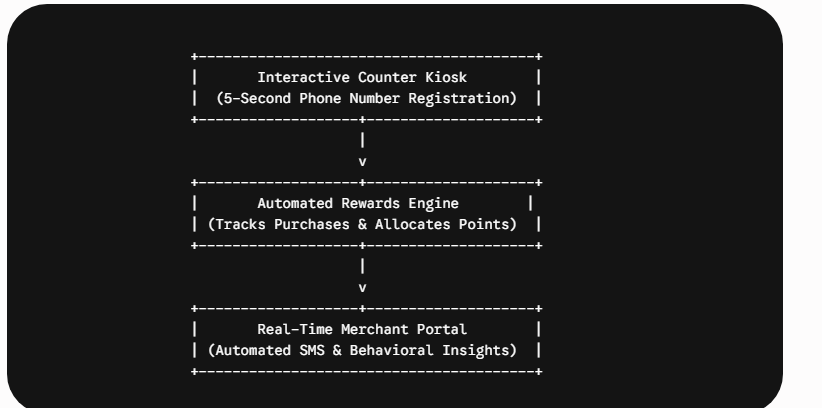
Moolah Points brings a sleek, customer-facing digital screen directly to your counter. Customers manage their entire rewards account on their own by typing their phone number on the screen while the cashier rings up items. This keeps your lines moving fast.
Automated Marketing and Smarter Messaging
Our platform doesn’t just sit passively at checkout. The system actively monitors buyer behavior. If a regular customer hasn’t visited your store in 14 days, the platform can automatically send a targeted text message with a special incentive to invite them back, running your customer retention strategies entirely on autopilot.
A Simple Dashboard for Busy Owners
You don’t need a degree in data analytics to improve your business. The easy-to-use Moolah Points merchant dashboard tracks your program’s health clearly, showing key insights—like your active member count, how fast points are being used, and how often people come back to shop—in a clean layout that is easy to read at a glance.
Lock In Your Customer Base with Moolah Points
A business built purely on one-off, transactional sales is inherently fragile. Without deep customer relationships, your storefront remains highly vulnerable to any online retailer or big-box competitor willing to undercut your prices on identical inventory. Competing solely on price is a race to the bottom. Shifting your focus toward a structured, loyalty-driven business model transforms your everyday foot traffic into a predictable, highly defensible, and long-term financial asset.
By introducing a clear digital rewards system, optimizing your checkout experience, and leveraging the automated marketing tools built directly into Moolah Points, you build a community of shoppers who feel valued. This consistent engagement ensures that your local customers bypass the competition and choose your storefront first, every single time.